
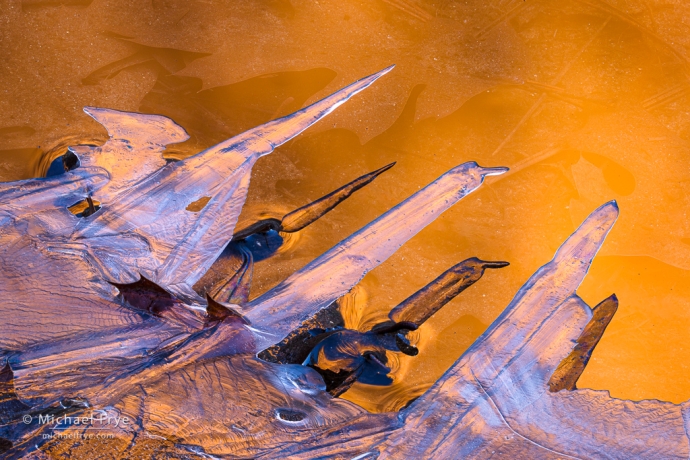
Ice fingers, Yosemite NP, California. 400mm, 1 second at f/16, ISO 100; 18 focus-stacked frames blended with Helicon Focus Professional. I wanted to {photograph} this element at an angle to get the orange reflections, requiring focus-stacking to get every thing sharp. (It’s a mirrored image of a cliff lit by the setting solar.)
Final Thursday, Friday, and Saturday two smaller storms moved by way of the Sierra, bringing rain and higher-elevation snow. However for a few weeks earlier than that it had been dry and heat – reaching the higher 60s at our home in Mariposa.
Early final week, as we have been beginning our workshop in Yosemite Valley, temperatures cooled off a bit, permitting ice to type alongside the banks of the Merced River. It’s at all times enjoyable to {photograph} ice like this, with its lovely patterns, designs, and colours. However it may be difficult, each technically and creatively.
I feel the inventive problem is usually about discovering sturdy, efficient compositions. With any topic I’m typically urging workshop college students to simplify and tighten up their compositions – to determine what’s important, and pare the {photograph} right down to that. What’s catching your eye probably the most? How are you going to get rid of every thing else however that, so the rest has most impression? With ice it appears much more necessary to get in shut. Actually shut. The smallest particulars are sometimes probably the most compelling.
And any composition – whether or not of an enormous scene or a small element – is simpler if it has a powerful design. Which means emphasizing repeating patterns, or fascinating strains or shapes. It means making a design within the {photograph}, slightly than simply presenting a topic.
I feel some images are extra subject-driven, however design nonetheless performs a significant supporting position. Different images are much less concerning the topic itself, and extra about design, mild, and (possibly) colour. I feel ice typically falls into that latter class; the very best ice images will not be a lot concerning the ice itself, however concerning the patterns and designs within the ice.
The technical problem with ice is getting all of it in focus. It’s comparatively simple to get every thing in focus when wanting straight down on the ice, in order that the ice is parallel to the movie or sensor. However in Yosemite Valley, I’m typically on the lookout for conditions the place the ice is within the shade, reflecting sunlit cliffs throughout the valley. These sunlit cliffs create lovely gold and even orange reflections within the ice or surrounding water. Nevertheless, you received’t see these colours wanting straight down, the place the ice is reflecting the sky instantly above; you solely see these colours at an angle, wanting towards the reflection of a cliff. And since you’re making an attempt to select a small, fascinating element with an extended lens, the depth of subject could be very shallow. Even at f/16 or f/22 it’s not possible to get every thing in focus with one body in these conditions. So which means focus-stacking.
Fortunately, the ice often isn’t transferring, making focus-stacking simpler. Many more recent cameras have automated focus-stacking (typically referred to as “focus bracketing” within the digital camera menu). You’ll be able to give attention to the closest factor to the digital camera (often on the backside of the body with ice pictures), activate the automated focus bracketing, and the digital camera will take a collection of pictures at farther and farther focus distances. (You continue to have to determine the fitting settings for this: the increment and variety of frames.)
Should you don’t have automated focus-stacking you’ll must do it manually. Begin by specializing in the closest a part of the scene to the digital camera (once more, often on the backside of the body with ice pictures), after which focus a bit farther again, then a bit farther again once more, and so forth, till you’re targeted on the farthest objects the image. You are able to do this with guide focus, or by transferring your autofocus level to completely different locations within the body.
It’s doable to make use of a reasonably extensive aperture for this, like f/8. However the wider the aperture, the much less depth of subject, and the much less focus overlap between frames, so that you’ll have to seize many extra frames to get every thing in focus from entrance to again. I want to cease down the aperture to f/16 in order that I can use fewer frames, which takes much less time, occupies much less area on my exhausting drives, and reduces the probabilities for error. (If there’s not sufficient overlap there’ll be a niche the place a part of the picture isn’t in give attention to any body.)
You need to use Photoshop to mix a focus-stacking sequence, however I a lot want the Professional model of Helicon Focus. (It’s on sale proper now. No, I don’t get a fee.) In lots of conditions, Helicon Focus does a greater job than Photoshop of mixing the pictures – of choosing the sharpest body for every a part of the photograph. The Professional model additionally has retouching, which will be helpful for eliminating ghosting with transferring topics. Better of all, the Professional model lets you export pictures from Lightroom to Helicon as DNGs, then save the ensuing blended picture as a DNG. So you possibly can course of that blended DNG like some other uncooked file, with all the ability and suppleness that gives.
Regardless of the challenges, I really like photographing ice. It’s simply water, probably the most considerable substance on our planet’s floor – however water became pure crystals, with lovely patterns and textures that mirror the colours of the world. It’s great stuff.
— Michael Frye
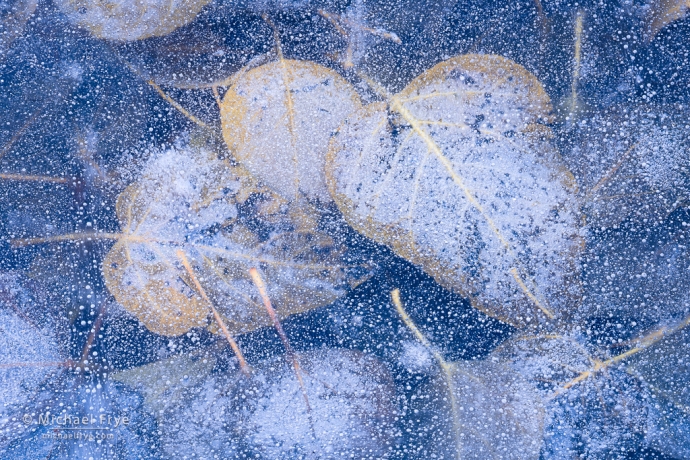
Cottonwood leaves encased in ice, Yosemite NP, California. 247mm, 1 second at f/16, ISO 100; Seven focus-stacked frames blended with Helicon Focus Professional. This was wanting extra straight down, however nonetheless at an angle, requiring focus-stacking to get every thing sharp.
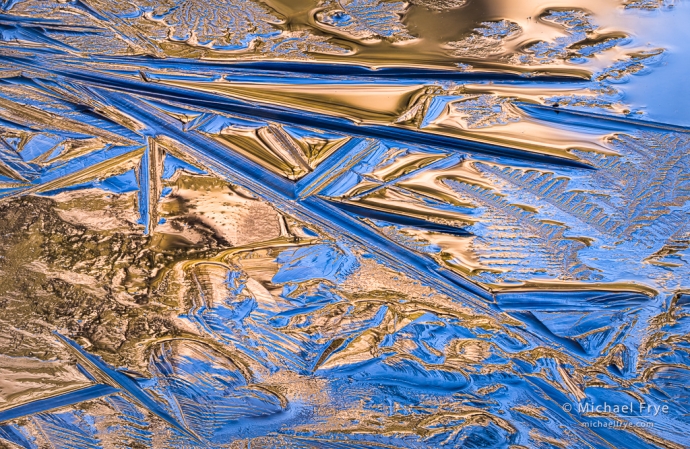
Ice and reflections, Yosemite NP, California. 400mm, 1/3 sec. at f/16, ISO 100; 34 focus-stacked frames blended with Helicon Focus Professional. I positioned the digital camera low to the bottom (possibly 18 inches excessive) to get the gold reflections. Wanting throughout the ice at such a low angle required many frames to get all of it in focus.
Associated Posts: Focus-Stacking Season; Melting Ice
Michael Frye is an expert photographer specializing in landscapes and nature. He lives close to Yosemite Nationwide Park in California, however travels extensively to {photograph} pure landscapes within the American West and all through the world.
Michael makes use of mild, climate, and design to make images that seize the temper of the panorama, and convey the sweetness, energy, and thriller of nature. His work has acquired quite a few awards, together with the North American Nature Images Affiliation’s 2023 award for Superb Artwork in Nature Images. Michael’s images have appeared in publications world wide, and he’s the writer and/or principal photographer of a number of books, together with Digital Panorama Images: Within the Footsteps of Ansel Adams and the Nice Masters, and The Photographer’s Information to Yosemite.
Michael likes to share his data of pictures by way of articles, books, workshops, on-line programs, and his weblog. He’s taught over 200 workshops targeted on panorama pictures, night time pictures, digital picture processing, and printing.