
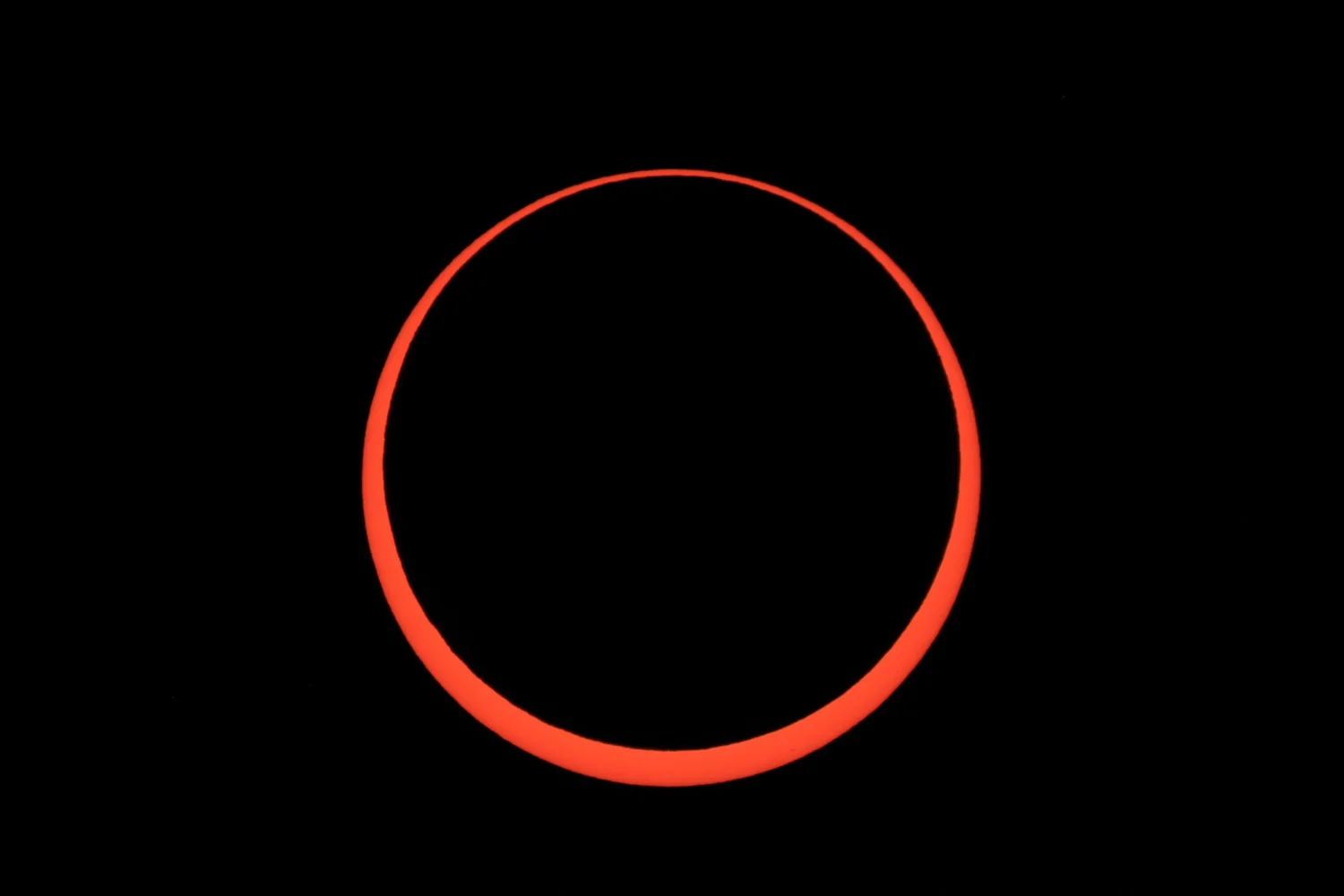
CAMERA SETTINGS
Settings are very subjective. Identical to any day or twilight shot, you might be inventive with adjusting your publicity for a desired impact that emphasizes motion, readability or depth.
Additionally observe that the publicity can range relying upon your filter energy, clouds within the sky and the way excessive the solar is (eclipses that occur low to the horizon might want to reduce via extra atmospheric haze, which reduces luminosity).
Your publicity will change because the eclipse progresses, and additional on in we’ll element what you’ll be able to anticipate, in chronological order.
We recommend studying via it a couple of instances to get comfy with how the sunshine, and subsequently your settings, will change over the course of some hours.
An excellent start line for exposing for the solar, with a photo voltaic filter on the lens, with clear skies, is:
1/500, f/8, ISO 800
Why these settings? These are protected settings that can play to the energy of most cameras and lenses for glorious picture high quality. Let’s clarify why:
Aperture
An aperture of f/8 is the candy spot for many lenses and won’t trigger excessive diffraction or flare. In case you are utilizing a telephoto lens, stopping all the way down to f/11 would additionally work and be extra within the candy spot.
Shutter Pace
The final rule for handheld telephoto images is to make use of a shutter pace that’s the reciprocal of your focal size. For instance, for a 500mm lens the shutter pace could be at the very least as quick as 1/500. Theoretically this prevents the picture from getting delicate attributable to digicam motion brought on by heavy gear.
That stated, we suggest that you just use a tripod and switch off VR/IS/OIS for the eclipse. It will make any comparatively quick shutter pace efficient. We’ve shot totality at as little as 2 seconds as a part of publicity brackets to get much more element within the corona. Nevertheless, through the partial phases the solar will probably be brighter and we will play to the safer shutter speeds between 1/125 and 1/1000 to the most effective sharpness. Even at quick shutter speeds, with lengthy lenses, attempt to set off your digicam along with your built-in or exterior intervalometer—this can assist stop any digicam shake.
ISO
That is in all probability probably the most subjective alternative. How comfy are you taking pictures along with your digicam at ISO 800, 1600, 3200 or 6400? If there are ISOs you need to steer clear of, you’ll be able to in all probability pull that off. This will probably be straightforward through the partial phases, as the brilliant solar will simply permit for ISOs of 100 to 800.
Nevertheless, as soon as the eclipse is 90 p.c full, issues begin to get darkish. Throughout totality the brightness will probably be equal to the start of nautical twilight. There will probably be a have to let in additional gentle, and ISO is normally the most effective setting to push up.
Be aware that the upper the ISO, the extra noise will probably be prevalent within the picture. Nevertheless, we discover that fashionable cameras (2020 and past) can simply deal with ISOs as much as 6400. Plus, as of late there are many methods to scale back noise with post-processing.
TELEPHOTO SHOT